Guides
Dry Texting: What It Means, Why It Happens & What to Do
Dry texting is a run of short, low-effort replies, "lol", "nice", "k", with no questions and no momentum. It almost always comes down to one of three things: they're genuinely busy, they're not that interested, or your texting styles simply don't match.
Those three causes feel identical from your side of the screen, which is why dry texting is so maddening. But they leave different fingerprints on a conversation, and telling them apart is the difference between relaxing, adjusting, and walking away.
What counts as dry texting
One flat day isn't dry texting: everyone has a Tuesday. It's a pattern when, over weeks, you see:
- Replies that answer the question and nothing else. No follow-up, no thread to pull.
- Zero questions coming back your way. You're the only one holding the door open.
- Reaction-only responses: "haha", a thumbs-up on your paragraph, an emoji where a sentence should be.
- You initiating almost every conversation, and the chat dying the moment you stop.
Busy, uninterested, or just a different style?
Genuinely busy
Busy people text short, but they text warm. The signs:
- Replies are brief but personal: they reference what you said, use your name, keep the joke alive in four words.
- They explain the gaps without being asked: "insane week, tell you Friday."
- Effort comes back when the crunch ends, and they often initiate the comeback.
- Plans still happen. Busy compresses messages; it doesn't cancel dinners.
Low interest
Low interest looks like busy, minus the warmth and minus the rebound:
- Short and flat. "nice" with nothing attached, indefinitely.
- They never initiate. Ever. The conversation exists only because you keep restarting it.
- No questions about your life: your news gets a "haha" and dies there.
- Plans stay vague: "yeah we should!" is where the idea goes to rest.
If several of these stack up alongside mixed signals: warm when they want something, dry the rest of the time, and the pattern is answering the question you keep asking your group chat.
Texting-style mismatch
Some people are simply dry in text and lovely everywhere else. The tells:
- They've been this way since day one: no decline, no cold snap, just a constant.
- They're engaged in person or on calls; the dryness lives only in the keyboard.
- They text everyone this way. Their best friend also gets "k".
- They show up: plans made, plans kept, effort visible in every channel except this one.
What to change (and what not to)
- Match their pace for a week or two. Not as a punishment, as an experiment. If they start initiating, it was circumstance. If the chat flatlines, that's data.
- Move the conversation somewhere better. A dry texter can be a great caller. Suggest voice, or skip straight to a plan.
- Ask one good question instead of five decent ones. Dry replies feed on low-stakes prompts. Give them something specific and easy to answer.
- Don't perform. Writing longer, funnier messages to compensate just widens the effort gap and teaches them you'll carry it.
- Don't play dead. Strategic silence to "win" isn't communication; it's a second dry texter entering the chat.
Double texting: when it's fine
Double texting, sending another message before they've replied, has an unearned bad reputation. The message content matters more than the count:
- Fine: a second text that stands on its own: new information, a funny thing that happened, a concrete plan. It doesn't demand a response to the first one.
- Fine: one follow-up after a genuinely dropped thread. People forget; phones eat notifications.
- Not fine: "?", or any message whose only content is pressure on the silence.
- Not fine: the escalating stack: five messages of increasing intensity into a void. That's not conversation anymore; it's a protest signal, and it says more about the anxiety in the dynamic than about your interest. (If that pattern feels familiar, the attachment styles in texting guide is worth your time.)
Who texts first: does it matter?
A single instance? No. Whoever thought of the other person first texted first; that's the whole story. What matters is the split over months. Nobody needs a perfect 50/50, but 90/10 is not a rhythm, it's a subsidy. If every conversation for the last three months started with your name on the first bubble, the initiation ledger is telling you who's holding this thing up. Count it across the whole history, not last week: one person carrying a bad month is normal; one person carrying the entire chat is the answer.
How Undertone reads this for you
You could tally initiations and reply lengths by hand, or let the transcript speak. Undertone takes a real conversation: import a WhatsApp chat export, or paste the conversation from Instagram, Snapchat, Tinder, Bumble, Hinge, iMessage, or Messenger. A three-question quiz sets the context: who you are, who they are, what this is. Then an explicit consent screen before anything runs: the chat goes to an AI provider (currently OpenAI, reached via OpenRouter) for one analysis, our own service never stores it, and it's never used to train AI models.
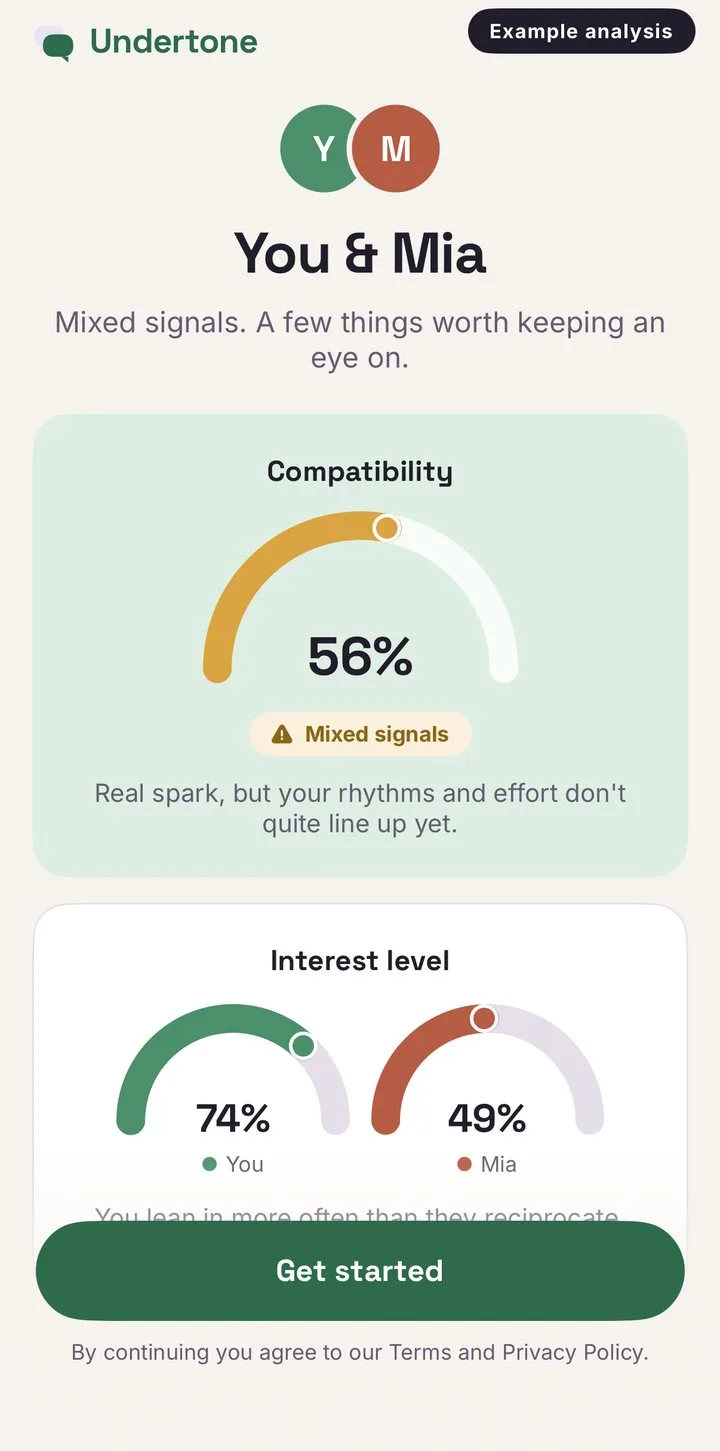
The result puts dry texting in numbers: a compatibility score, interest level for both sides, red and green flags decoded, and the dynamics underneath: who initiates, message-length balance, reply rhythms, plus suggested conversation starters if the read says it's worth another push.
FAQ
What does dry texting mean?
Dry texting is a run of short, low-effort replies, "lol", "nice", "k", with no questions and no momentum. It usually means one of three things: the person is genuinely busy, their interest is low, or their texting style simply doesn't match yours.
Is dry texting a red flag?
Not by itself. Dry texting becomes a warning sign when it's paired with never initiating, never asking questions, and plans that stay vague. If someone is dry in text but warm in person and consistent about showing up, it's a style, not a signal.
Should I stop texting someone who dry texts me?
First match their pace for a week or two and watch what happens. If they start initiating and effort returns, it was circumstance. If the conversation only exists when you push it, you have your answer: the pattern across the whole chat tells you more than any single reply.
Stop rereading the chat.
Undertone launches soon on the App Store: $29.99/year or $4.99/week, no free trial.
Get early access