Guides
Texting Compatibility Test: What Your Conversation Actually Scores
A real texting compatibility test measures how well two people's messaging styles fit: reply rhythm, effort balance, who initiates, humor mirroring, and the depth of the questions you ask each other. The honest version doesn't ask how you feel about the conversation. It reads the conversation.
That distinction matters more than it sounds. There are two kinds of "test" on the internet: quizzes that score your mood, and analysis that scores your transcript. Only one of them can surprise you.
What texting compatibility actually means
Compatibility over text isn't about texting a lot. It's about whether two styles mesh. Five factors do most of the work:
| Factor | Matched looks like | Mismatched looks like |
|---|---|---|
| Rhythm match | Similar reply tempos; gaps don't spook anyone | One replies in minutes, one in days, and both resent it |
| Effort balance | Message lengths roughly mirror each other | Paragraphs answered with "lol nice" |
| Initiation split | Both start conversations over time | One person carries 90% of the openers |
| Humor & emoji mirroring | Jokes land and get built on; emoji dialects converge | Bits die on arrival; one side is deadpan, one is confetti |
| Depth of questions | Real curiosity: questions about your life that go somewhere | Small talk on a loop; nobody asks anything |
None of these requires mind reading. Every one of them is sitting in your chat history right now, countable, with timestamps.
Why quizzes about feelings mislead
The classic compatibility quiz asks things like "Does he seem excited to hear from you?", and then grades you on your own optimism. Three problems:
- You're the least neutral witness available. If you're smitten, every "haha" reads as excitement. If you're anxious, every delay reads as doom. The quiz measures the mood you brought to it.
- You answer as the person you want to be. "Do you give each other space?" Sure. Ask the transcript how much space five unanswered messages counts as. (The dry texting guide covers what that pattern actually means.)
- It's a snapshot of one moment. A quiz taken after a great date scores differently than the same quiz on a quiet Sunday. The conversation itself doesn't have moods: it has months of consistent, checkable behavior.
Meanwhile the actual evidence, who initiates, how fast replies come, whether questions run both ways, already exists in writing. Testing your feelings about the data, instead of the data, is how people end up shocked by an ending the chat had been announcing for weeks.
What a fair score looks like
A compatibility score you can trust has three properties:
- It's a percentage with a verdict, not a horoscope. "56%: Mixed signals" tells you something actionable. "You two are like fire and ice!" does not.
- It scores both sides. Compatibility is a two-person measurement. Any test that only evaluates them is flattery or paranoia, depending on the day.
- It shows its work. The score should come with the evidence: the initiation split, the rhythm gap, the flags it found, so you can argue with it. A mismatch isn't a verdict of doom, either; it's a map of where the friction lives, which pairs well with knowing the red flags in texting worth taking seriously.
How Undertone reads this for you
Undertone runs the test on the real thing. Import a WhatsApp chat export, the richest input, or paste the conversation from Instagram, Snapchat, Tinder, Bumble, Hinge, iMessage, or Messenger. A three-question quiz personalizes the read: who you are, who they are, and what this relationship is. Then, before anything runs, an explicit consent screen: your chat is sent to an AI provider (currently OpenAI, reached via OpenRouter) for a single analysis, our own service never stores it, and it's never used to train AI models.
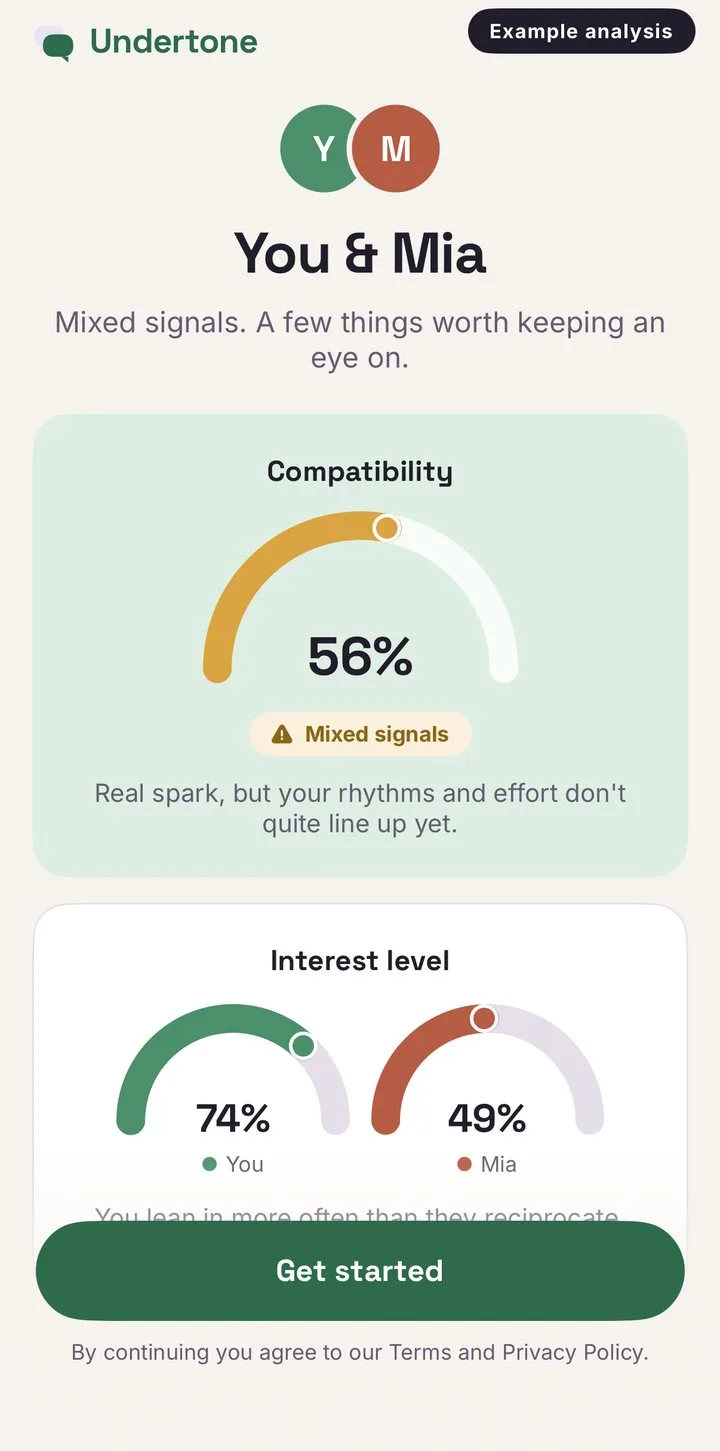
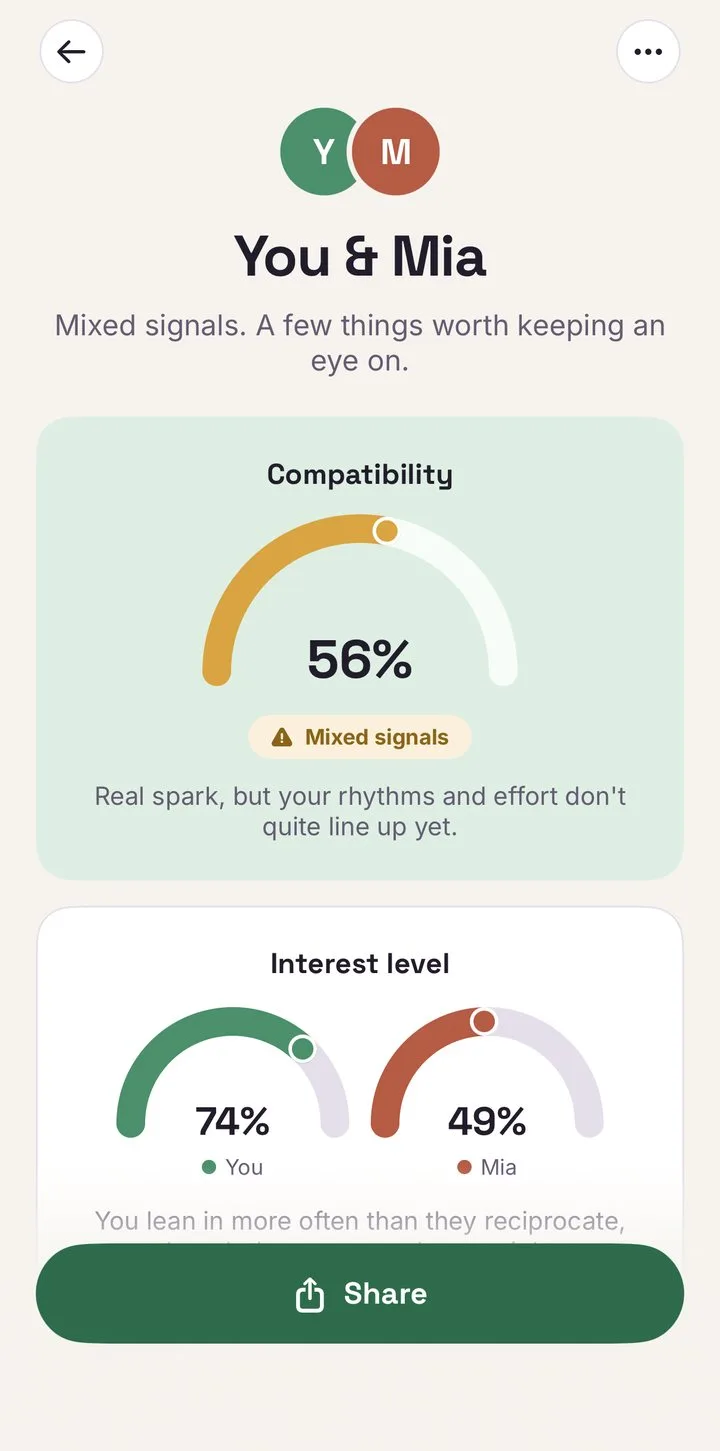
The analysis returns a compatibility percentage on a meter with a plain-English verdict: "Mixed signals", "Strong signals", plus interest level for each side separately, so you can see asymmetry instead of guessing at it. Around the score: red and green flags decoded, the relationship dynamics (initiation, reply rhythms, message-length balance, monthly activity), and suggested conversation starters for the next move.
FAQ
What is texting compatibility?
Texting compatibility is how well two people's messaging styles fit: reply rhythm, effort balance, who initiates, humor and emoji mirroring, and the depth of questions asked. It's measurable from a real conversation, no quiz required.
How is a texting compatibility score calculated?
A meaningful score reads the actual transcript: it compares reply rhythms, message-length balance, initiation split, mirrored humor, and question depth across the whole history, then expresses the fit as a percentage with a plain-English verdict, like 56% with a verdict of "Mixed signals".
Can texting compatibility change over time?
Yes. Compatibility is a snapshot of how two styles are meshing right now, and it moves as effort, rhythm, and initiation shift. That's why re-running the analysis on the same chat after a few months is often more revealing than the first score.
Stop rereading the chat.
Undertone launches soon on the App Store: $29.99/year or $4.99/week, no free trial.
Get early access